Common Mercedes-Benz Sprinter Repairs: 4 Real Case Studies
A Sprinter is rarely just a van. For a tradie it carries the tools and the day's income. For a courier it's the whole business, and for a camper owner it's the holiday. So when a warning light comes on, the power drops off, or the air conditioning starts blowing warm on a 35-degree day in Newcastle, it costs you more than a repair bill.
The most expensive mistake we see is replacing parts before anyone has tested anything. A new alternator won't fix a corroded earth strap. A new DPF won't fix a sensor that's telling the engine computer the wrong number. Modern Sprinters carry dozens of control units that talk to each other constantly, and one bad input can light up symptoms that look completely unrelated.
Let's have a look at four real Sprinter jobs from our workshop:
- a battery warning with multiple electrical faults,
- a DPF concern with restricted performance,
- an air conditioning compressor that wasn't building pressure
- a towed-in van that wouldn't start.
For each one we cover what the owner was dealing with, what we found, what was done, and what it means for you if your van shows the same signs.

Real Workshop Case Studies For Mercedes-Benz Sprinter
Case Study 1: Battery warning lights and intermittent electrical symptoms
What the customer faced
Battery warnings, radio interruptions and interior electrical faults kept coming back. The owner had already tried replacing charging components, and the problems continued anyway. That's a frustrating spot to be in: money spent, and the van no more reliable than before.
How Star Auto Works solved it
What we found: A specialist charging-system assessment found an underlying electrical connection issue, rather than simply another failed component.
Repair and outcome: The connection issue was corrected, and charging voltage at the battery returned to normal.
What a charging-system assessment involves
When battery warnings come with radio dropouts and other electrical glitches, we don't start by replacing the alternator or battery. On a fault like this, the assessment typically covers:
- A scan of the van's control units, not just the engine. When several unrelated modules have logged supply-voltage faults, the problem is often their shared power supply rather than the modules themselves.
- Resting battery voltage. A healthy, fully charged 12-volt battery sits around 12.6 V with the van off and settled.
- Charging voltage at the battery terminals. With the engine running, expect roughly 13.8 to 14.8 V depending on temperature and charge level. Later vans with ECO start-stop manage the alternator smartly and can read lower on purpose, so we check the target value in live data before calling anything faulty.
- Voltage-drop testing under load. With headlights, blower fan and other loads on, we measure across each cable and connection. More than about 0.3 V lost on the positive side, or 0.2 V on the earth side, points to a connection resisting current.
On NCV3 Sprinters (2010 to 2018), the battery sits under the floor at the driver's footwell. Wet boots, leaking door seals and soaked floor mats can corrode terminals, the pre-fuse box studs and nearby earth points over time. The main engine-to-body earth strap and the alternator output stud are other connections we check on any Sprinter with charging complaints.
Workshop service note
Complaint: Battery warnings, radio interruptions and interior electrical faults, continuing after the owner replaced charging components.
Cause: Charging-system assessment identified an underlying electrical connection issue rather than a further failed component.
Correction: Connection issue corrected. Charging voltage at the battery returned to normal.
Same lesson on petrol Mercedes (M278 V8). Owners of 2011 to 2017 models with the M278 twin-turbo V8 (S500, CL500, ML500, GL500, SL500 and CLS500) can see the same "one cause, many symptoms" pattern. The camshaft adjuster solenoids on these engines can leak oil internally, and that oil can wick along the wiring harness towards connectors and the engine computer. The result can be cam-timing codes such as P0011 or P0014, plus other sensor faults on the same harness. Replacing a solenoid without checking the harness for oil risks the fault returning.
Why it matters: Multiple electrical symptoms can have one underlying cause. Accurate diagnosis helps avoid unnecessary parts replacement.
Case Study 2: DPF warning light and engine power restriction
What the customer faced
This Mercedes-Benz Sprinter came in with a diesel particulate filter (DPF) concern and restricted performance that needed professional assessment. For a working van, reduced performance means slower jobs and an owner who can't trust the van on the motorway.
How Star Auto Works solved it
What we found: Testing confirmed two problems at once: excessive DPF loading, and a pressure-sensing fault.
Repair and outcome: A replacement sensor was fitted and a controlled regeneration as performed. Follow-up driving checks showed the loading value remained satisfactory at that time.
Why the Sensor matters as much as the filter
The DPF is a ceramic filter in the exhaust that traps soot. The engine periodically burns that soot off, which is called regeneration. On a long highway run this can happen on its own. Otherwise the engine computer triggers an active regeneration, adding extra fuel to push exhaust temperatures up to around 600°C for a short period.
To decide when the filter needs cleaning, the engine computer relies on a calculated soot model and on pressure sensing across the filter. A loaded filter creates a bigger pressure difference between the inlet and outlet, a bit like breathing through a dirty mask.
If the pressure signal is wrong, the computer makes the wrong decisions. It may treat the filter as more loaded than it is and limit performance. Or it may not trigger regeneration when it should, letting soot genuinely build up. That's why a DPF job with both excessive loading and a pressure- sensing fault has to address both.
On a DPF concern on an OM651 or OM642 Sprinter, our checks typically include:
- Fault memory in the engine control unit, read with XENTRY so we see Mercedes-specific fault details and the conditions when each fault was stored.
- Pressure reading with the engine off. With no exhaust flow, the DPF pressure reading should be at or very close to zero. A reading well above that suggests a sensor or signal problem.
- Pressure response with the engine running. The reading should rise smoothly with engine speed. Erratic readings can point to the sensor, its wiring, or the small pressure hoses, which can crack, come loose or block.
- Soot and ash values in live data. Soot can be burned off. Ash can't, so a high ash value means regeneration alone won't solve the problem.
- Engine oil level. Repeated unsuccessful regenerations can add diesel to the engine oil and raise the level, which needs attention in its own right.
A controlled regeneration also needs the right conditions: engine at operating temperature, enough fuel in the tank, and no other faults preventing it from running.
The outcome on this van was checked on follow-up drives, and loading was satisfactory at that time. How the filter behaves afterwards still depends on how the van is used. Lots of short, low-speed trips give the DPF fewer chances to regenerate, so we talk owners through driving patterns as part of the job.
Decoding common DPF fault codes
| Code | What it means | What it can point to |
|---|---|---|
| P2002 | DPF efficiency below threshold | Filter damage, or implausible sensor readings |
| P2452 | DPF pressure sensor circuit | Wiring, connector or sensor fault |
| P2453 | DPF pressure sensor range or performance | Implausible reading, or a split, loose or blocked sensor hose |
| P2454 / P2455 | DPF pressure sensor signal low / high | Sensor or wiring fault, sometimes a blocked hose |
| P2463 | DPF restriction, soot accumulation | Filter heavily loaded, often from short trips or interrupted regenerations |
| P242F | DPF restriction, ash accumulation | Non-burnable ash build-up; filter may need cleaning or replacement |
These are generic OBD codes. XENTRY adds Mercedes-specific fault details and the live soot and ash values that most generic scanners can't read.
Workshop service note
Complaint: DPF concern with restricted performance.
Cause: Testing confirmed excessive DPF loading and a pressure-sensing fault.
Correction: Replacement sensor fitted. Controlled regeneration was performed. Follow-up driving checks showed loading value satisfactory at that time.
Why it matters: DPF faults need assessment of the monitoring system as well as the filter condition.
Case Study 3: Loss of cabin air conditioning and poor cooling
What the customer faced
The Sprinter came in with air conditioning that wasn't cooling correctly. In a big-glass van cabin over a Lake Macquarie summer, that's more than discomfort. It adds to driver fatigue, and for anyone carrying passengers or temperature-sensitive goods it's a real problem.
How Star Auto Works solved it
What we found: A system assessment found that the compressor was not producing the required pressure.
Repair and outcome: We quoted the owner for a compressor replacement.
Why we test before regassing or replacing
Poor cooling has three broad causes: not enough refrigerant (usually from a leak), a mechanical fault such as the compressor, or an electrical or control fault that stops the system working as designed. A regas only addresses the first, and only for a while if a leak remains. So the system is assessed before anything is refilled or replaced.
On a Sprinter AC complaint, the assessment typically covers:
- Refrigerant type and charge. Most 2010 to 2018 Sprinters use R134a, and many later vans use R1234yf. The label under the bonnet confirms which. Recovering and weighing the refrigerant against the factory figure is the accurate way to confirm the charge.
- Static pressure, engine off. A system holding roughly the pressure expected for the outside temperature still has refrigerant in it. Near-zero pressure suggests a leak.
- Running pressures. On a warm 25 to 30°C day, the low side typically sits around 1.5 to 2.5 bar and the high side around 10 to 17 bar. A compressor that isn't pumping properly tends to show a low side that's too high and a high side that's too low.
- Electrical control. Mercedes compressors of this era are typically variable-displacement, with the climate control system commanding how hard the compressor works. A spinning pulley doesn't prove the compressor is pumping, so the command signal, pressure sensor reading and condenser fan operation are checked as well.
A compressor replacement quote also needs to account for the rest of the system. When a compressor wears internally it can shed fine particles. Depending on what's found, a proper replacement to the manufacturer's procedure can include flushing, replacing the receiver-drier and expansion valve, and filling with the correct compressor oil and exact refrigerant quantity. Vans with rear roof-mounted AC, common on minibuses and campers, carry more refrigerant and pipework, which also affects the job.
Workshop service note
Complaint: Air conditioning not cooling correctly.
Cause: System assessment found the compressor was not producing the required pressure.
Correction: Compressor replacement quoted.
Why it matters: Air conditioning diagnosis should establish the reason for poor cooling before major components are replaced.
Case Study 4: Tow-in breakdown and starting failure after battery discharge
What the customer faced
This Sprinter arrived at our Warners Bay workshop on a tow truck. Its battery had discharged and the van could not be started. For the owner, that meant a lost day, a tow bill and the worry of whether it would happen again.
How Star Auto Works solved it
What we found: Charging attempts did not initially restore a stable battery condition.
Repair and outcome: The battery was removed for external charging, refitted once charged, and the vehicle was started.
Why a flat battery doesn't always recover on the van
A 12-volt battery is fully charged at about 12.6 V. Below roughly 12.0 V it's heavily discharged, and if it sits low for long, lead sulphate hardens on the plates. A deeply discharged battery can pick up a surface charge from a quick boost, then collapse when the starter motor asks for several hundred amps.
Modern Sprinters add another layer. The engine computer, immobiliser and other control units need stable voltage to wake up and communicate, so a weak battery can cause a no-crank, or a crank with a dash full of unrelated warnings. Removing the battery for external charging lets it be brought up slowly and evenly on a workshop charger, away from the van's electrical load. On most Sprinters the battery sits under the floor on the driver's side, below the footwell.
What comes after the restart
Getting the engine running is one stage of assessing a battery-related breakdown. The next question is why the battery went flat. A full assessment can include:
- Battery condition testing. A battery tester checks real cranking ability against the battery's rated cold cranking amps (CCA). A deeply discharged battery can be weakened even after recharging.
- Charging output. Confirming the alternator puts charge back into the battery while driving.
- Parasitic drain. With everything off and the van locked, its modules should go to sleep, which can take 30 minutes or more. After that, current draw should be very low, typically under about 50 mA. Fridges, inverters, dash cams, trackers and camper conversion wiring are frequent culprits.
On later vans with ECO start-stop, a replacement battery must be the correct type, often AGM, and registered with the van's battery management.
Workshop service note
Complaint: Vehicle arrived by tow truck. Could not be started after battery discharge.
Cause: Battery discharged. Charging attempts did not initially restore a stable battery condition.
Correction: Battery removed for external charging, refitted once charged. Vehicle started.
Why it matters: A successful restart is only one stage of assessing a battery-related breakdown.
Key takeaways for Mercedes-Benz Sprinter owners in Warners Bay
Four different vans, four different faults, and the same lessons kept coming up:
- Root cause analysis beats parts swapping. In Case 1, replacing charging components didn't solve the problem because the cause was a connection issue.
- Monitoring systems matter as much as hardware. The DPF job in Case 2 involved a pressure-sensing fault as well as filter loading. Both had to be dealt with.
- Find the reason before replacing major parts. In Case 3, a system assessment showed the compressor wasn't producing the required pressure before any replacement was recommended.
- A restart is just step one. Case 4 shows that getting a van started isn't the end of assessing a battery-related breakdown.
Why modern Sprinter diagnostics need more than a generic code reader
A $50 OBD2 scanner from an auto parts store reads mostly the emissions-related engine codes that every car must report by law. That's a small slice of a Sprinter. A 2010 to 2020 Sprinter has many control units for the engine, transmission, ESP braking, instrument cluster, body electrics, climate control and more, and most of their faults never appear on a generic tool.
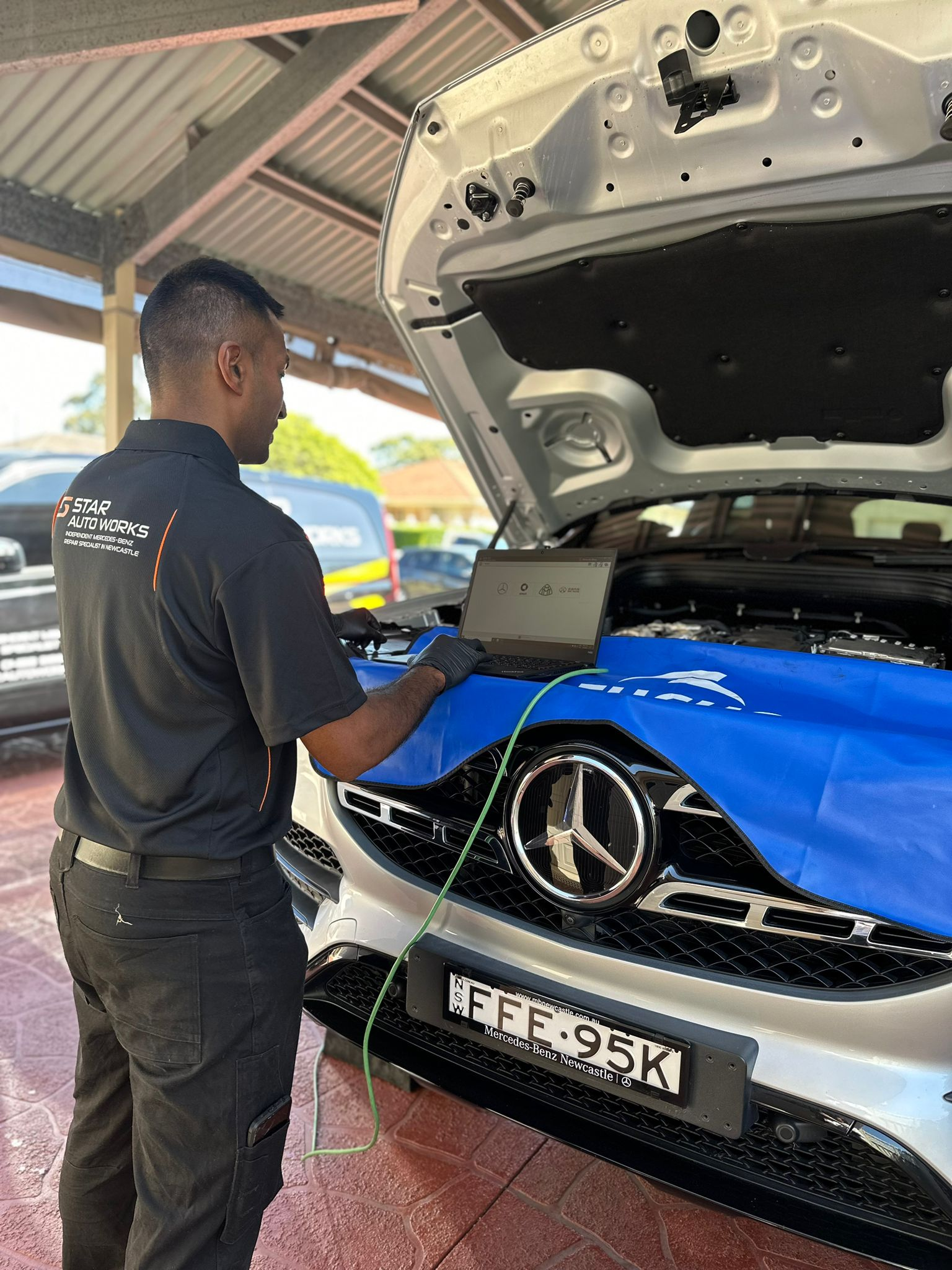
Mercedes-Benz XENTRY diagnostics, used alongside wiring diagrams, multimeters and oscilloscopes, lets us:
- Read fault memory across the van's control units, with manufacturer codes and the conditions when each fault was stored
- View live data a generic tool can't see, such as DPF soot and ash values, AC pressure readings and the charging system's target voltage
- Run guided tests and service functions, including stationary DPF regeneration, battery registration and component adaptations
- Follow Mercedes wiring diagrams and repair procedures for your exact van
That's the difference between reading a code and actually diagnosing a van.
Keep your Sprinter running at peak performance
Small symptoms are cheaper to fix than breakdowns. A battery light that keeps coming back, a DPF warning or AC that fades in traffic are worth checking early. Book a Diagonstic Inspection or your next scheduled service at our Warners Bay
Mercedes Benz workshop, serving Newcastle and Lake Macquaire.
Contact Star Auto Works and fill out our questionnaire, we'll more that happy to have a look at your vehicle. You can also give us a call on 0422 986 649 or visit us directly at our garage at Unit 1/5 Walker Street, Warners Bay, NSW 2282.