Mercedes-Benz Engine Problems: Common Symptoms and Causes
Mercedes Benz is known for its luxury, comfort and elegance. One of the major reasons people opt for Mercedes Benz among other high-end luxury cars is because of its beautiful look and driving comfortability. Even though the engineering behind it is premium and of great quality, issues can occur anywhere. Since it is incredibly precise and unique, the solution to common issues also needs that sophisticated touch for smoother resolutions. If you are wondering about the common Merceds-Benz engine problems, their symptoms and causes, this guide will help you figure it all out.
Quick Answer
Mercedes-Benz engines are quite durable and efficient. However, some of the most common Mercedes engine issues are stretched timing chains, oil leaking into electrical components and carbon buildup choking the valves. You should never ignore warning signs like a metallic rattling noise when starting the engine or a shaking idle. Ignoring smaller problems at their earlier stages will turn into bigger problems over time that eventually cost you a fortune.
The Most Common Mercedes-Benz Engine Problems: Symptoms And Causes
Mercedes-Benz engines are quite durable, but time definitely has an effect on them. Over a period of time, the intense heat cycles under the hood lead to function failure in many components. This eventually causes problems like oil leakage or internal consumption.
1. Engine Oil Leaks And Excessive Combustion
This happens because Mercedes engines heat up quite quickly and over the period of time it results in the breaking of the rubber seals, which causes either oil to leak internally or to burn away externally.
- Symptoms: Oil leaks and excessive combustion can be identified easily because when that happens, the oil leaks outside and lands on the hot parts of the engine, resulting in a burning smell or sometimes it also leaves dark oil puddles in your driveway. You can also catch this early by checking the oil alerts you find during car services.
- Causes: Over the period of time, as the engine gets older, the valve around it degrades, this also causes issues such as, hardened valve cover gaskets, oil cooler seals, worn valve stem seals, or degraded piston rings.
- Engine Notes: Frequently seen in M272 and M273 engine families.
2. Timing Chain Stretch And Hydraulic Tension Rattle
The timing chain is what coordinates the top and bottom halves of your engine so everything works perfectly and in harmony. A small stretch in that chain results in the entire self destruction of the engine.
- Symptoms: The most common symptoms are that you will hear a distinct metallic sound or loud rattle while starting the engine. Your check engine light will also turn on.
- Causes: Over time, due to high mileage, the chain holding the engine together stretches and causes elongation. This happens especially in models like M271, M272, M274.
- Risk Level: A skipped tooth can cause valve to piston contact and complete engine failure.
3. Engine Misfires, Rough Idling And Power Loss
A misfire means one or more cylinders inside your engine are failing to ignite the air and fuel mixture properly. This is concerning because when an engine misfires it completely looses it rhythm and affects fuel efficiency and performance.
- Symptoms: One easily identifiable sign is the shaking of the vehicle during traffic stops. You can also find out the issue by checking the tachometer needle, it will usually fluctuate between 600 to 700RPM. You may also notice a sluggish throttle response.
- Causes: The causes are mainly because of worn out spark plugs, failing coil packs, clogged fuel injectors or air/vacuum leaks. There is also an added risk of the destruction of catalytic converters when the unburned fuel enters the exhaust line.
4. Cooling System Failures And Rapid Overheating
Generally, Mercedes-Benz engines produce a massive amount of heat, relying on a highly complex network of valves, sensors and pumps to stay cool. When these components fail, it results in a sudden surge in the engine's temperature.
- Symptoms: While checking the temperature gauge, you will notice that the temperature exceeds up to 80 to 90 degree Celsius. You can also look for the dashboard alerts that show low coolant or if you see steam under your car bonnet.
- Causes: Cooling system failure mainly causes because of plastic water pump impeller degradation, stuck electronic thermostats, leaking radiators or failing head gaskets.
- Risk level: Aluminium cylinder heads can warp or crack within minutes of severe thermal overload.
5. Balance Shaft Gear Wear : M272 Engine Family
This is one of the most famous and expensive engine flaws among Mercedes- Benz cars. The balance shaft is an internal component made to balance the natural shaking of an engine and thereby providing a smoother and bump-free riding experience.
- Symptoms: Excessive engine vibration at idle, rough running and stored camshaft timing error codes.
- Causes: Premature softening and wear of the balance shaft sprocket teeth, shifting ignition timing
Model Spotlight: Specific Engine Vulnerabilities
The Mercedes engine problems and other possible issues, even though most of them are similar across all Mercedes models, let's look into and compare some of the major issues of 4 different top Merecedes-Benz models.
Mercedes-Benz C-Class (W204 vs W205 Generations)
On the W204, such as the C300, the big worry is worn balance shaft gears in the M272 engine. This eventually becomes an expensive problem to solve for the owners. They also had problems with the timing chain tensioner because it wears with age, and the Electronic Steering Lock (ESL) module sometimes locks up too. Things took a different turn when it comes to the W205 model. Owners started encountering issues like failing
electronic thermostats and worn front suspension arm bushings. There was also problems with the auxiliary battery or sensor since they had an odd glitch.
Mercedes-Benz E-Class and GLC-Class (W212, W213, X253)
Owners of a W212 or W213 E-Class often face leaks from the AIRMATIC air suspension, either at the compressor or at a strut. Oil cooler seals break down on these cars often, and the timing chain stretches as the kilometres add up. The X253 GLC-Class has a different list of problems. Diesel versions can throw AdBlue heater or NOx sensor faults, and upon usage the direct-injection fuel injectors wear. They also suffer from frequent
electronic thermostat warnings.
Next time when you go for a car service, make sure to ask your technician to check for these specific known engine problems according to your make and model.
Advanced Mercedes-Benz Diagnostics: Why ECU Scans and Physical Checks Matter
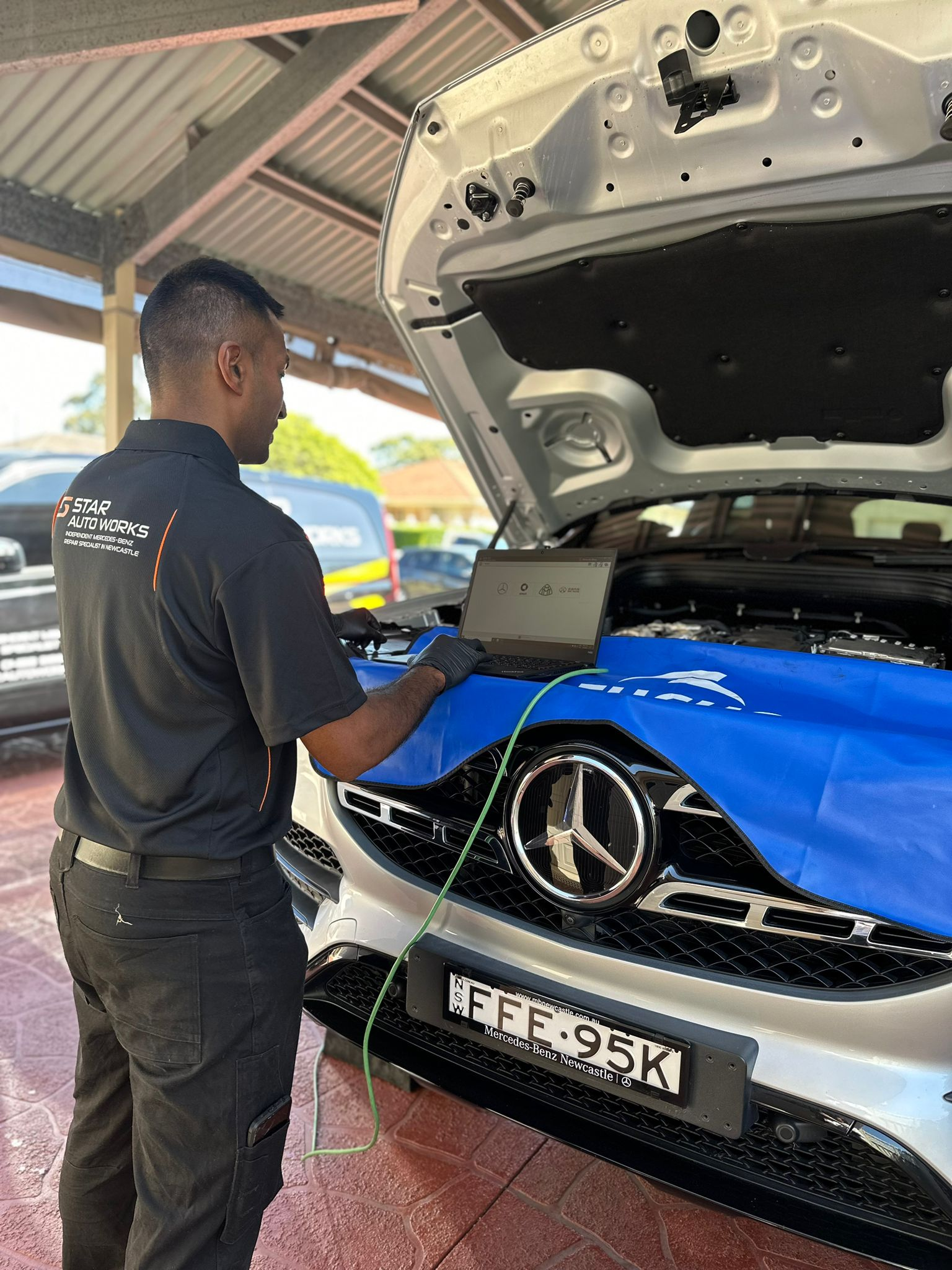
Reading codes only tells you half of what's actually happening. In order to have a proper Mercedes-Benz engine diagnosis, you must go for an ECU scan along with physical testing by an experienced professional. The handheld OBD2 readers sold in most shops only pick up basic codes. On the other hand, the Mercedes-Benz ECU detects and stores its own codes and data from individual sub-systems, while those cheap readers
frequently skip them.
When you take your car to service, you may notice that with the right equipment, the professional technician watches the engine work. Live data shows fuel trim, mass airflow, ignition timing, and fuel rail pressure while the engine still runs.
Then comes the hands-on part. A healthy cylinder should read between 150 and 180 PSI on a compression test. Leakdown tests help identify where a cylinder loses pressure, and smoke testing finds vacuum leaks that no code points to. That data, along with the mechanical proof gives you an answer on Mercedes-Benz diagnostics whether the symptom is an engine misfire, rough idling, or a stubborn check engine light.
Frequently Asked Questions
Here are a few answers to common questions about Mercedes engine problems and Mercedes-Benz engine symptoms.
Is it safe to continue driving my Mercedes-Benz when the check engine light glows steadily?
The usual answer is yes. If the light is glowing in a steady manner and you feel no major issues while driving, then the wise decision would be to take it to a Mercedes specialist. But if you see the light is flashing and your engine misfires, pull over quickly and call for immediate assistance. Because driving in such conditions can wreck the catalytic converter or the engine itself.
What causes the rattling noise in my Mercedes engine when it's cold?
This is usually caused when the chain stretches or because of an overnight oil pressure drop by the hydraulic tensioner. That weird rattling noise that you hear fades once the oil pressure returns back to normal. A quick diagnosis goes a long way. Because early detection and solution of an issue like this stops the chain from jumping a tooth and hitting the valves.
Why does my Mercedes-Benz check engine light come back on after I reset it?
Clearing a code is not a solution, you are just simply erasing the existence of an issue. When you clear a code, it only wipes the warning. The ECU spots the same misfire next time you start your drive, the sensor reads and realises the issue and switches the light right back on. You can only make it disappear with a proper service and repair.
Conclusion: Trust Newcastle's Mercedes-Benz Engine Specialists
Star Auto Works located in Warners Bay is your one stop solution for all your Mercedes problems. All our Mercedes specialists are trained specifically to work with Mercedes cars. Their highly advanced techniques and tools are designed to solve Mercedes engine problems. Since Mercedes-Benz engine issues often signal themselves from an early stage through burning oil odour, a startup rattle, or a flickering dashboard light, and such addressing these warning signs promptly ensures road safety, maintains driving comfort, and preserves the vehicle's resale value.
Contact Star Auto Works if you have any queries related to your Mercedes.